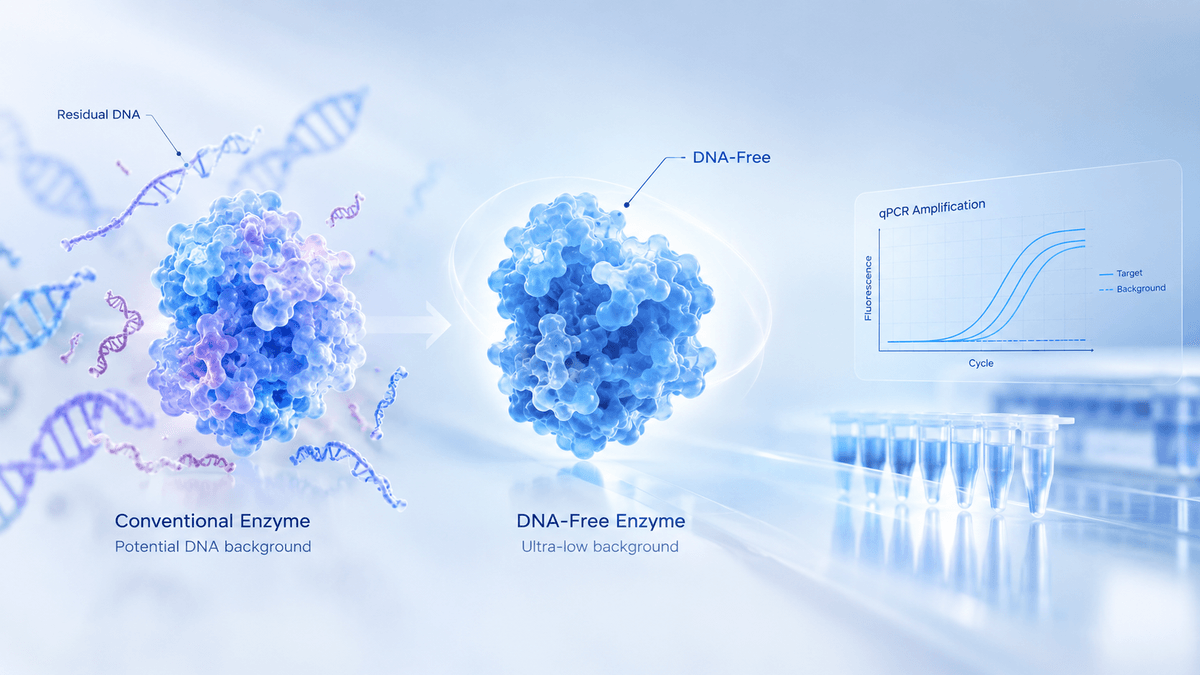
For many years, enzyme selection in molecular biology has focused primarily on performance. Researchers typically evaluate an enzyme based on its activity, specificity, fidelity, stability, and compatibility with a particular reaction system.
These characteristics remain fundamental.
However, as molecular detection technologies continue to become more sensitive, another aspect of reagent quality is receiving increasing attention: background contamination originating from the reagents themselves.
This issue is particularly relevant when the target nucleic acid is present at very low abundance. In such applications, even a small amount of background DNA may become more significant because PCR and other amplification-based technologies can convert trace nucleic acid into a readily detectable signal.
As a result, for certain high-sensitivity molecular workflows, researchers are beginning to consider not only how well an enzyme performs, but also what the enzyme may contribute to the background of the reaction.
This is where DNA-Free enzymes can provide an important additional level of control.
When Higher Sensitivity Also Means Greater Sensitivity to Background
The fundamental strength of PCR is its ability to amplify very small amounts of nucleic acid.
This extraordinary amplification capability has transformed molecular biology, enabling applications ranging from pathogen detection and genetic testing to microbiome research and molecular diagnostics.
At the same time, amplification creates an inherent challenge: nucleic acid that is not part of the intended target can also become amplified if it is compatible with the assay.
For high-abundance targets, a small amount of background DNA may have little practical effect on the final result.
The situation can be different when the target is present at very low levels.
In these experiments, the relationship between target signal and background becomes increasingly important:
High-abundance target
Target signal >> Background
Low-abundance target
Target signal ≈ Background
As the target approaches the detection limit, controlling potential sources of background becomes increasingly important for reliable interpretation.
This is one reason why reagent-derived DNA contamination has received particular attention in low-biomass microbiome studies and broad-range microbial detection.
A recent study examining nine commercially available PCR enzymes found detectable bacterial DNA contamination in seven of the tested products. The authors highlighted the potential implications for microbiome research, particularly when samples contain very low levels of bacterial DNA.
Importantly, this does not mean that conventional PCR enzymes are unsuitable for routine molecular biology.
Rather, it demonstrates that the appropriate level of reagent purity depends on the sensitivity and requirements of the application.
The Reagent Itself Can Be a Source of Background
When an unexpected signal appears in a molecular assay, researchers generally consider a number of possible sources:
Sample contamination
- Cross-contamination during pipetting
- Primer or probe-related issues
- Water and buffers
- Plastic consumables
- Laboratory environment
- Aerosolized DNA
- Reagent-associated nucleic acid
- The last factor can sometimes receive less attention.
Recombinant enzymes are produced using biological expression systems. During manufacturing, the target enzyme must be separated from host-cell components, including nucleic acids.
Although purification processes are designed to remove these impurities, trace amounts of host-derived genomic DNA or plasmid DNA may remain if they are not specifically controlled.
For many routine applications, such trace levels may not be practically significant.
However, in applications involving very low DNA input or broad-range amplification, the situation can be different.
This issue has been recognized for many years in microbial detection and microbiome research. Earlier studies reported bacterial DNA contamination in PCR reagents and extraction reagents, while more recent work continues to demonstrate that reagent-derived DNA can complicate analysis of low-biomass samples.
The 2025 consensus guidelines published in Nature Microbiology further emphasized that low-biomass microbiome studies are particularly vulnerable to contamination because external DNA can become disproportionately important when the biological signal is close to the detection limit. The guidelines recommend validating the integrity of reagents and incorporating appropriate negative controls when working with low-biomass samples.
Why Low-Biomass and Broad-Range Applications Are Particularly Challenging
Microbiome research provides a useful example of why reagent background matters.
In a conventional PCR assay, researchers may be looking for a specific target sequence.
In broad-range microbial detection, however, the objective can be much broader—for example, detecting bacterial DNA using conserved regions such as the 16S rRNA gene.
This creates a particular challenge.
The experiment is designed to detect a wide range of bacterial DNA, while the reagent itself may potentially contain bacterial DNA.
In a high-biomass sample, the contribution from reagent-derived DNA may be negligible.
In a low-biomass sample, however, the same background may represent a much larger proportion of the total detectable signal.
This is why studies of low-biomass microbiomes often require extensive negative controls and careful evaluation of reagent-associated contamination.
The same principle can apply to other highly sensitive molecular workflows.
Where DNA-Free Enzymes Can Add Value
DNA-Free enzymes are not intended to replace conventional molecular biology enzymes in every application.
Instead, they provide an additional option for workflows where minimizing reagent-derived DNA is important.
Potential applications include:
High-Sensitivity PCR and qPCR
When assays are designed to detect low-copy targets, reducing potential background sources can help improve confidence in negative controls and low-level results.
This can be particularly relevant for assays involving low-abundance targets or broad-range detection.
Microbial Detection
For microbial detection assays, the identity of the DNA matters.
If the assay is designed to detect bacterial DNA broadly, background bacterial DNA originating from reagents can become particularly relevant.
DNA-Free enzymes can therefore be considered as part of a broader strategy for controlling reagent-derived background.
Low-Biomass Microbiome Research
Low-biomass samples represent one of the most challenging environments for DNA-based microbial analysis.
When the amount of microbial DNA in the sample is extremely low, reagent-associated DNA may account for a larger fraction of the detectable signal.
In such workflows, DNA-Free reagents can be combined with appropriate negative controls, clean laboratory practices, and careful sample processing to reduce potential sources of contamination.
NGS and Low-Input Workflows
NGS can detect very small amounts of nucleic acid, but high analytical sensitivity also increases the importance of controlling background.
Reagent-associated nucleic acids may become relevant in low-input or contamination-sensitive workflows, particularly when microbial sequences are being analyzed.
DNA-Free enzymes can therefore be considered as one component of a broader reagent-quality strategy.
Molecular Diagnostics and Assay Development
For diagnostic developers, reagent quality is not only a research consideration.
It can become part of the overall performance and quality-control strategy of an assay.
In these applications, factors such as lot-to-lot consistency, background control, enzyme activity, stability, formulation, and long-term supply may all need to be considered together.
DNA-Free Does Not Mean “Zero DNA”
One important point deserves clarification.
The term DNA-Free should not be interpreted as an absolute claim that a biological reagent contains literally zero DNA molecules under every possible analytical condition.
In practice, DNA-Free enzyme development focuses on minimizing residual DNA to a defined and validated level using an appropriate detection method.
For example, qPCR can be used to evaluate residual DNA signals under defined testing conditions.
SBS Genetech uses qPCR-based testing for its DNA-Free enzyme products, with current product specifications indicating Ct >40 under the relevant testing conditions.
This distinction is important because the appropriate definition of “DNA-Free” depends on the analytical method, detection limit, assay design, and intended application.
For researchers, the more useful question is therefore not simply:
“Is the enzyme completely free of DNA?”
but rather:
“Is the level of residual DNA sufficiently controlled for my application?”
This is a much more practical way to evaluate a DNA-Free reagent.
DNA Removal Must Be Balanced with Enzyme Performance
Removing residual DNA is only one part of the challenge.
A molecular biology enzyme must still function as an enzyme.
Additional purification or DNA-control steps should not compromise:
Enzyme activity
- Specificity
- Fidelity
- Thermal stability
- Storage stability
- Reaction compatibility
- Lot-to-lot consistency
- For this reason, DNA-Free enzyme development is not simply a matter of adding another purification step.
It requires an integrated approach that considers the entire production and quality-control process.
At SBS Genetech, DNA-Free enzyme development combines optimized purification strategies with enzyme performance evaluation and residual DNA testing. The goal is to reduce DNA background while maintaining the functional characteristics required for downstream molecular applications.
From Standard Reagents to Application-Specific Enzyme Development
As molecular biology applications become more specialized, a single standardized enzyme formulation may not always meet every requirement.
A research laboratory may simply need a DNA-Free version of an existing polymerase.
A diagnostic developer may require a specific enzyme with optimized activity in a proprietary reaction buffer.
A biotechnology company may need a customized enzyme for a new molecular assay, followed by stable bulk supply or OEM manufacturing.
These projects can involve very different technical requirements.
Depending on the application, development may include:
Enzyme selection
Selection of an appropriate polymerase, reverse transcriptase, nuclease, or other enzyme according to the intended workflow.
Expression optimization
Optimization of the recombinant expression system to achieve suitable yield and enzyme quality.
Purification and DNA control
Development of purification strategies designed to reduce residual host-derived DNA while preserving enzyme activity.
Functional characterization
Evaluation of enzyme activity, stability, specificity, and compatibility with the intended reaction system.
Residual DNA testing
Evaluation of DNA background using appropriate analytical methods such as qPCR.
Application validation
Testing the enzyme in the customer's intended molecular workflow rather than evaluating the enzyme solely as an isolated reagent.
This application-oriented approach is particularly relevant for commercial assay development, where the final requirement is not simply a high-quality enzyme, but a reagent that performs consistently within a specific product or workflow.
SBS Genetech DNA-Free Enzyme Portfolio
SBS Genetech has developed a portfolio of DNA-Free enzymes designed for molecular workflows where low DNA background is an important consideration.
The current portfolio includes DNA-Free versions of several commonly used molecular biology enzymes and reagents, including:
DNA-Free Taq DNA Polymerase
- DNA-Free HS-Taq DNA Polymerase
- DNA-Free HS HiFi Taq DNA Polymerase
- DNA-Free Pfu DNA Polymerase
- DNA-Free HS Pfu DNA Polymerase
- DNA-Free Tli and Deep Tli DNA Polymerases
- DNA-Free Tth DNA Polymerase
- DNA-Free Thermostable M-MLV Reverse Transcriptase
- DNA-Free RNase T
- DNA-Free RT-qPCR SuperMixes
- DNA-Free UDG qPCR SuperMixes
- The portfolio is designed to cover different PCR, qPCR, reverse-transcription, and related molecular biology workflows.
For researchers who need a ready-to-use reagent, standardized DNA-Free enzyme products can provide a convenient option.
For organizations with more specific requirements, the same technology can be extended to customized enzyme development.
Custom DNA-Free Enzyme Development
Not every DNA-Free enzyme requirement can be addressed by an existing catalog product.
Some projects require a specific enzyme, a particular formulation, a defined activity range, or compatibility with a proprietary assay.
SBS Genetech provides customized DNA-Free enzyme development for research groups, diagnostic developers, biotechnology companies, and other organizations with application-specific requirements.
Depending on the project, the development scope can extend from enzyme selection and expression optimization to DNA-controlled purification, functional validation, formulation development, and larger-scale manufacturing.
For commercial projects, OEM and bulk manufacturing can also be considered once the required enzyme specifications and production conditions have been established.
This provides a development path from:
Research requirement → Enzyme development → Application validation → Scale-up → Commercial supply
rather than limiting DNA-Free technology to individual research-grade products.
Looking Beyond Enzyme Activity
The development of molecular biology reagents has always followed the needs of the applications they support.
As assays become more sensitive, the requirements for the reagents used in those assays inevitably become more demanding.
Activity remains fundamental.
But for some applications, it is no longer the only consideration.
Purity, stability, consistency, background control, and application compatibility can all influence the reliability of the final workflow.
DNA-Free enzymes represent one example of this broader evolution in reagent development: from simply enabling a reaction to providing greater control over the reaction environment.
For routine molecular biology, a conventional enzyme may be entirely appropriate.
For applications involving low-abundance targets, broad-range microbial detection, low-biomass samples, or other contamination-sensitive workflows, however, controlling reagent-derived DNA may deserve a more prominent place in experimental design.
Ultimately, the right enzyme is not necessarily the one with the longest list of specifications.
It is the one whose performance and quality characteristics are appropriate for the demands of the application.
For researchers and developers working at the limits of molecular detection, background control can be an important part of that equation.
Learn more about SBS Genetech DNA-Free Enzymes and custom development solutions: SBS Genetech DNA-Free Enzymes